
If you’re buying a pocket tool for real everyday use, you want to know one thing first: does it actually solve problems you face every day — or is it just a cute keychain trinket?
That’s exactly the question the Victorinox Swiss Army Classic SD has had to answer for nearly nine decades. Despite being made in the millions and showing up on countless “best-of” lists, this tiny multi-tool isn’t for everyone. It’s incredibly light and convenient — but it is limited in what it can really do.
I’ve carried one of these on my keyring for 5 years, I’ll break down the real value you’ll get out of it – when it’s worth choosing over a bigger knife or multi-tool, and when it isn’t.
The nice thing is that it’s cheap! (Check the latest price on Amazon)
In This Classic SD Review:
- Cost
- Specs
- Pros & Cons
- Overview
- Tools
- Build Quality
- History
- Model Variants
- Conclusion

Cost: ~$25
On the low end, you can usually pick up a regular Classic SD for around ~24$ and it goes up from there depending on options.
Who the Swiss Army Classic SD Is For
The Classic SD is for people who want maximum usefulness with zero friction. If a tool isn’t light, discreet, and easy to carry every single day, you won’t carry it — and an unused tool is worthless.
This knife shines if you:
- Want something you can always have on you, even on a keyring
- Deal with small, annoying, everyday problems (loose threads, packaging, hangnails, tags, splinters)
- Value reliability and build quality over raw capability
- Don’t want to think about weight, bulk, or legality
It’s especially good for:
- Minimalists
- Urban EDC
- Travel
- People who don’t normally “carry tools” but still run into minor problems daily
In short: if you want a tool that quietly earns its keep without demanding attention, this is exactly that.
Who the Classic SD Is Not For
The Classic SD is not a substitute for a real knife or multi-tool, and pretending it is will only lead to disappointment.
You should skip it if:
- You expect to do any kind of serious cutting
- You want pliers, drivers, or leverage
- You regularly work outdoors, on vehicles, or on gear
- You already carry a larger knife or multi-tool
This knife is limited — intentionally so. If you buy it expecting “Swiss Army magic” to overcome its size, you’ll be frustrated. It solves small problems extremely well and stays out of the way the rest of the time.
Quick Verdict (Before the Details)
The Swiss Army Classic SD is worth it if you value carry-consistency more than capability.
It’s not impressive.
It’s not powerful.
It doesn’t try to be.
But it does get carried — and that’s why it works.
If you want one tool that quietly handles dozens of light-duty tasks you didn’t even realize you’d face, the Classic SD punches far above its size. If you want something that feels like a tool, look elsewhere.
The Details
By comparison the, Classic SD is a little longer and wider than a AA battery but weighs about the same.
- Weight: 0.8oz (21g)
- Length: 2.3 inch (58 mm)
- Width: 0.4 inch (9.9 mm)
- 6 Tools: Blade, Scissors, File, Flat screwdriver, Toothpick, Tweezers
- Keyring
- Blade steel: DIN X55CrMo14 stainless steel
- Handle material: ABS / Cellidor

Pros
- Very affordable
- Extremely practical
- Best EDC keychain tools out there
- Very light and discreet
- Easy to sharpen & takes a keen edge
- Rust-proof, maintenance-free metal.
- Relatively robust
Cons
- For light-duty tasks only
- Limited tools
- non-locking blade and tools
- Sometimes awkward to use while on a keychain(consider combining with carbiner style keychain like this one on Amazon)
Classic SD Overview

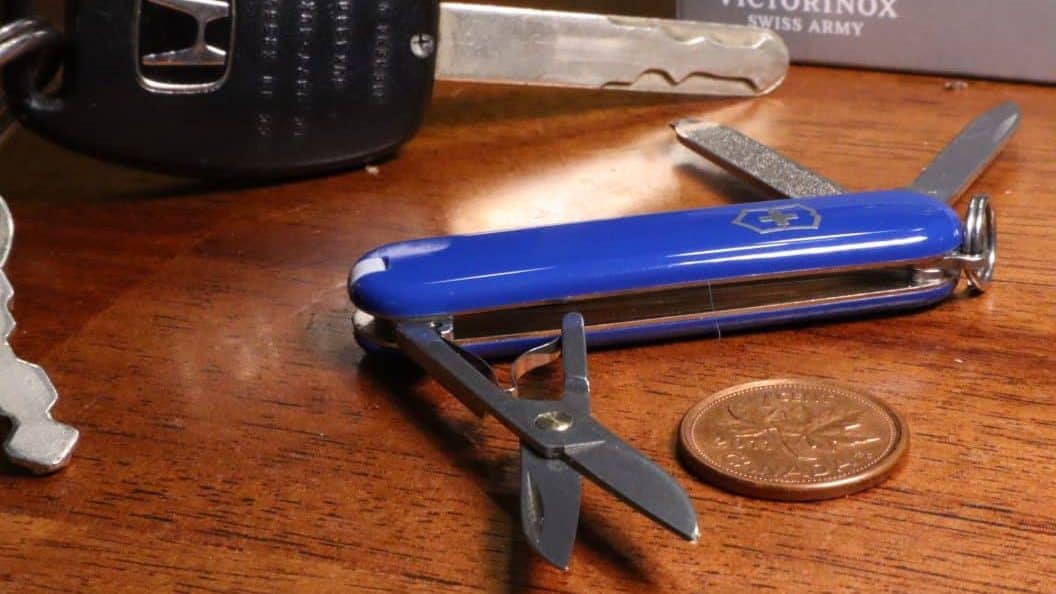
The best place for the Classic SD is on your keychain. In general, your keys go everywhere you do. The SD is actually .15oz lighter than my Honda Accord’s key (Yes, I did actually measured it.) In other words, it adds no noticeable bulk to your keyring at all.
The Classic SD perfectly embodies that old saying, that “The best tool is the tool you have”
You don’t have to remember to bring it because it’s already on your keychain. That is 90% of the issue with EDC knives..you actually have to remember to bring them.
I use my Classic SD far more than my Leatherman Wave simply for this reason. Even though my Leatherman is far more capable.

Tools
1 1/2 -Inch Blade

This blade isn’t meant for power or hard use. It’s for precision and control
What I use the knife for:
- Opening packages
- Sharpening pencils
- Slicing apples, scoring oranges, etc
- Cutting string
- Opening plastic packaging
- Breaking down boxes
The Swiss-forged stainless DIN X55CrMo14 steel is a cutlery industry favorite known for its exceptional corrosion resistance. It holds an edge surprisingly well for its size, but it’s not a “work knife.” If you try to force it into that role, you’ll hate it.
The blade features an aggressive drop-point– where the spine curves downwards towards the point. This is handy for opening packages without snagging and damaging the contents.
Overall quality is good. No rust after 5 years, no side-to-side play on the hinge, and the action is smooth.
Scissors

What I use the scissors for:
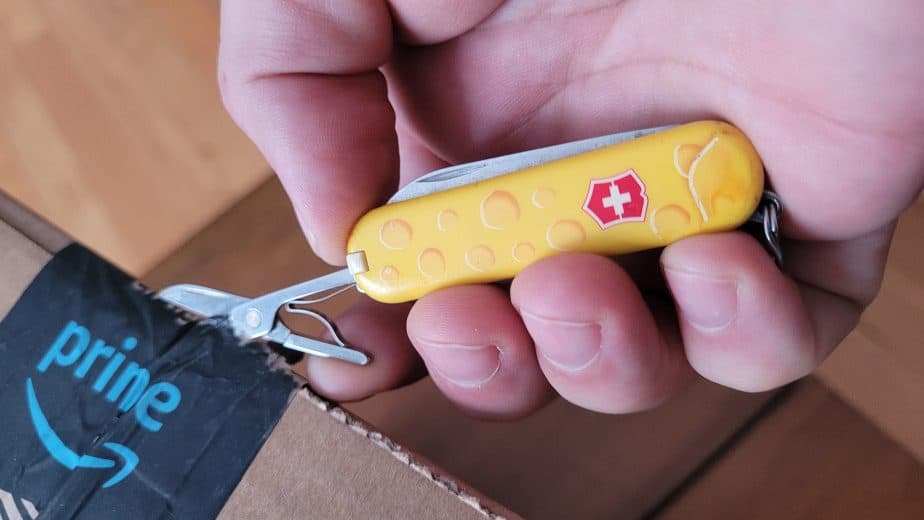
- Opening Amazon packages
- Removing loose threads and tags
- Cutting electrical tape
For me the scissors are the next most used tool on the Classic SD Swiss Army knife. I find the blades are sharp with a smooth, tight action. There is no pinching or slippage.

The scissors are also surprising ergonomic for such a tiny tool. Your thumb operates the top spring-loaded lever while your other fingers can grip the body of the tool for better control and more precise cuts. .
Replacement scissor springs are available on Amazon if you ever manage to wear them out.
Nail File

The nail file is a handy tool for a quick manicure..not something I do regularly, but I have used it in tandem with the scissors when I forgot my nailclippers on long trips.
The file surface is a medium grind and doesn’t wear down easily. My only complaint is that the file surface does not extend to the edge of the blade, which I think would far more usability.
What I use the nail file for:
- filing my nails
- Cleaning corroded battery terminals
- Sharpening small instruments
- Envelope opener– a bit ugly, but it works
Screwdriver

The “SD” in Classic SD stands for the “Screw Driver”
You’ll find it integrated into the tip of the file blade. The screwdriver is a small flathead(roughly 1/8″(2.5mm) wide.) In a pinch, the head is narrow enough to also work on certain Phillips head(star-shaped) screws.
What I use the screwdriver for:
- screws(imagine that)
- cleaning my nails
- scraping crud
- wedging open plastic shells on remotes, phones and other electronics
This screwdriver is no “torque monster,” but it’s plenty enough for everyday stuff. Also, FYI, it is not small enough to tighten eyeglass screws. I wish it were.
Toothpick

Having a toothpick is handy. They can spare you a lot of embarrassment after lunch at work. I admit I’ve used it for this purpose quite a few times.
What I use the toothpick for:
- Cleaning crevices in your dashboard
- Clean crumbs from your keyboard,
- Pressing those tiny reset buttons on electronics
It’s not sharp and is made from a soft and flexible plastic. Its held inside the knife-handle slot by friction and small notch near the base.
The toothpick and the tweezers are replaceable. If you ever lose or damage one you can order new ones on Amazon.(earned commission)
Tweezers

With a square cut tip, these aren’t exactly the most precise tweezers ever, but they are certainly adequate for common slivers and minor hair removal.
However, I find the steel tip of the tweezers are robust enought to use for a lot more than just picking up stuff.
What I use the Tweezers for:
- Hang nails
- Slivers
- Ingrown hair removal
- Etching my name on stuff
- Marking measurments
- Scraping residue, rust, and corrosion
- Crevice tool/cleaner
Like the toothpick, the steel tweezers find their home in the end of the Classic SD’s handle and are replaceable if need be.
Keyring Attachment
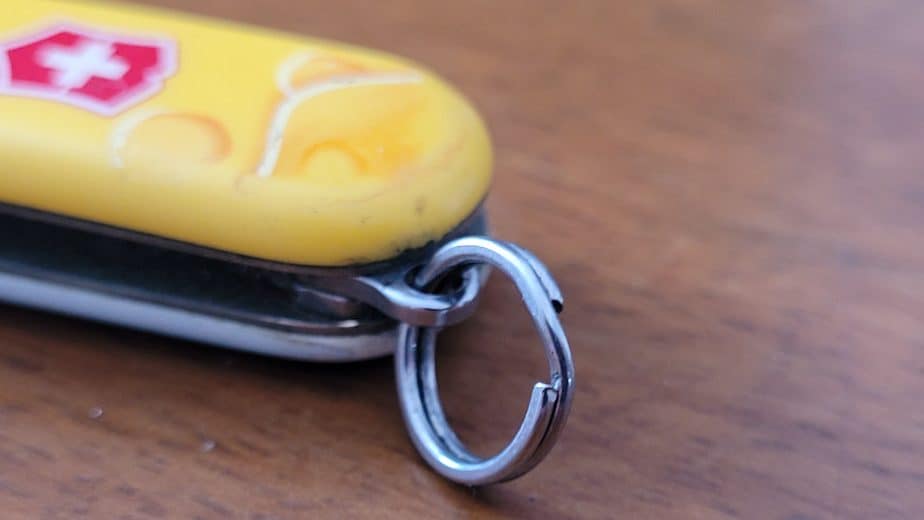
This is not a “feature.” It’s the entire reason the Classic SD works.
Because it lives on your keys:
- You don’t forget it
- You don’t debate carrying it
- You don’t leave it behind
That consistency is the real advantage.
Build Quality

Given that this knife can be had for as little $25. (check latest pricing at BladeHQ) I think it is remarkably well-built for its price point. Even after
Even after 5 years of regular use every component is working just fine. That’s actually quite remarkable.
The body of the Classic SD is made from rust-resistant aluminum alloy. Brass rivets and bushings hold the knife together and separate the components. I don’t know what else to say except that it stands up to regular light duty use without any worries.
In reality, the most likely scenario is that you lose this knife long before you break it.
My only complaint is that the plastic scales(outer plastic handle) get scratched easily. Frankly I dig the scars. But, if that is an issue for you, you can always upgrade to something like Alox versions (Amazon Link). Just keep in mind that those version do not have the toothpick or tweezers.
The History Of the Classic SD
The Swiss Army Classic is not the oldest Swiss Army knife model, but it has had a heck of a long production run(84 years!) It is very likely the most prolifically produced Swiss Army of all time.
According to my research, the Classic SD’s design actually debuted in 1935. While the size and tiny form factor have remained largely unchanged since then, my research indicates it originally only came with a nail file, nail cleaner and knife. However, I can’t be sure. The toothpick and tweezers are said to be have been added in 1942.(source.)
The knife went through several name changes and refinements over the years until finally settling on the name “Classic” somewhere in 1970’s. The name, “Classic SD,” came a little later when the nail cleaner on the end of the nail file was swapped for a flathead screwdriver.


You can peruse more old photos at SAKwiki’s archive

US and German patents were applied for in 1952. This was likely a move to protect profits because Swiss Army knives suddenly became very popular after WW2, especially among allied troops who were bringing them home as gifts(source.)
Interestingly, a pencil eraser was among the original proposed tools on the patent:
“Between these shells there are pivoted a number of implements e. g. a blade 2, a nail file 3, an eraser 4, or the like such as scissors etc, on rivets. “
US Patent # 2718695
Variants of the Classic SD (58mm size)
I don’t think it is possible to do a Classic SD review without also pointing out Victorinox’s large wider family of 58mm multitools inspired by the Classic SD.
Since size and weight is a restriction, each 58mm variant has its benefits and tradeoffs compared to the Classic SD. Typically, the tools are interchanged to make the tool more suited for specific purposes.
Here are a couple other major 58mm variants and how they differ from the original Swiss Army Classic SD:
NailClip 580
The NailClip 580(Amazon) is a very handy(pun intended) manicure tool. The only thing you lose from the classic SD is the flathead screwdriver. You gain 15 grams and It is available in various colors too.

- Additional Tools: Nail Clipper, nail cleaner
- Removed Tools: Flat Screwdriver
- Additional Weight: 15g (36g total)
Mini Champ
The Mini-Champ(Amazon) is the same length(58mm) and but sports a lot more functions-(18 Total!) Of course, this also makes it thicker and heavier.
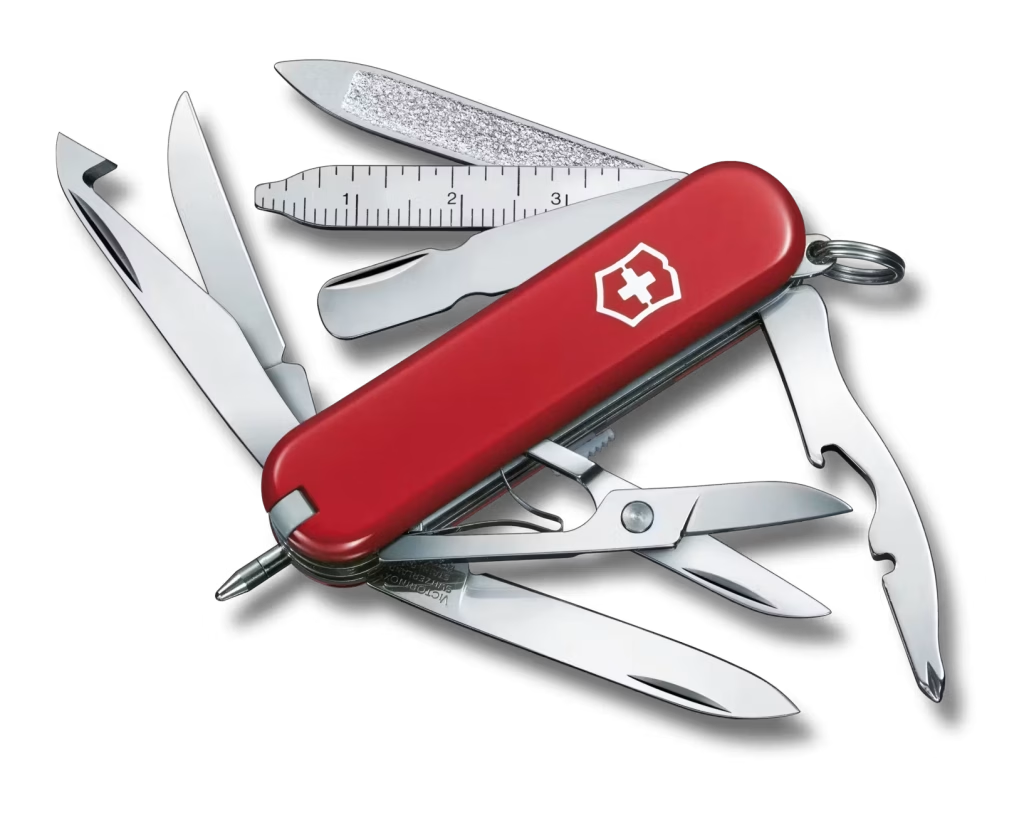
- Tools: Letter opener / Blade, small / Bottle opener / Phillips screwdriver 0/1, magnetic / Wire stripper / Screwdriver 2.5 mm / Ruler (cm) / Ruler (in) / Scissors / Nail file / Nail cleaner / Cuticle pusher / Orange peeler / Scraper / Key ring / Tweezers / Toothpick / Pressurized ballpoint pen
- Additional Weight: 24g (45g total)
Final Conclusion: Why I Still Carry The Classic SD
I’ve carried the Swiss Army Classic SD almost every day for many years, including overseas travel and daily life at home. It’s been to Africa and back. It’s opened packages, trimmed loose threads, cleaned fingernails, tightened screws, and solved dozens of daily annoyances that would otherwise require finding a “real” tool.
What makes it valuable isn’t what it can do — it’s that it’s always there when you need it.
Most EDC gear fails not because it’s bad, but because it’s inconvenient. The Classic SD avoids that trap entirely. It’s small enough to disappear, yet useful enough to justify its place.
If you’re honest about what you actually need day to day, and you value tools that earn their keep quietly, this little knife still deserves its well-earned reputation.